
2025 Housing Snapshot Report
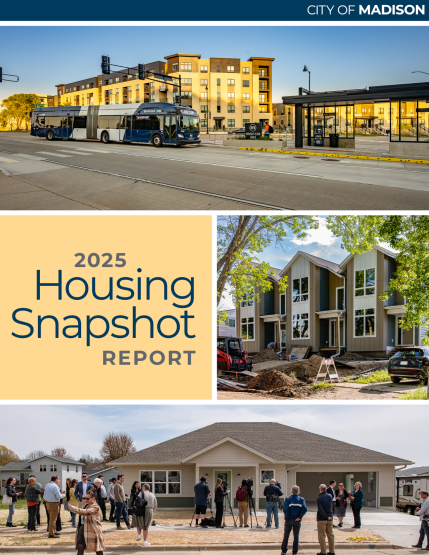
The 2025 Housing Snapshot tracks and compares metrics to lead to a clearer understanding of the City of Madison’s housing needs and to gauge progress that City programs, community partners, and housing developers are making over time to improve housing choice. We use a mix of economic, demographic, and housing data from public and private sources to help describe Madison’s housing situation.
Building on data updates from the 2023 Housing Snapshot, this report is reorganized and includes new metrics and data visualizations responsive to 2025 input from the City’s Housing Policy Committee, including a new set of “Example Households” to convey more about who lives here in Madison to a broad audience.
Many takeaways echo the 2023 Housing Snapshot, and both reports continue to inform housing policies and programs. While housing production has increased, growth in housing demand still outpaces new supply and land and construction costs continue to increase rapidly, resulting in continued competition and fewer housing choices, particularly for low-income households.
Here are some 2025 Housing Snapshot highlights:
-
Rental Housing Market
- At time of publication, the City’s stabilized rental vacancy rate has risen to 4.8%, approaching a healthy level (typically 5%–7%). The lowest vacancy rates (indicating highest competition) are seen in lower quality, lower cost rental housing.
- Roughly ¾ of renter-households making over the median income rent housing that would be affordable to low- and moderate-income households, reducing housing choices for these households.
- Household incomes are diverging more than rent costs, meaning higher-income households have more choices and lower-income households have fewer choices than they did a decade ago.
- Of the estimated 17,105 households who are either very low-income renters or experiencing homelessness, roughly 1 in 3 are cost-burdened non-student households with a lack of subsidized or otherwise affordable housing.
Significant racial and ethnic disparities in rental housing affordability persist, though over the last decade, the rent affordable to a median-income Hispanic or Latino household has risen from below median rent to $200 above median rent, indicating a potential increase in housing choice.
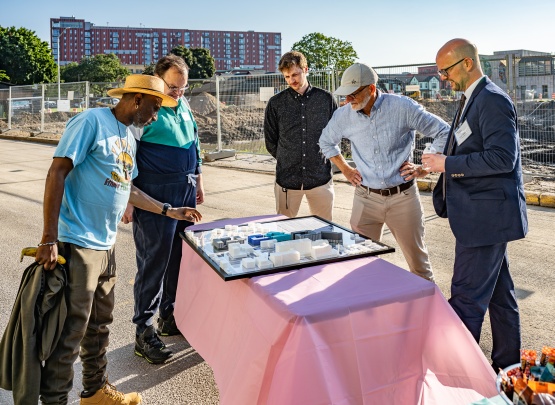
Attendees of the August 2025 groundbreaking at the CDA Triangle examine a 3D printed model of the proposed Triangle redevelopment (scheduled for completion in 2035). -
Housing Cost Burden
Nearly half of all Black households and 30% of White households are housing cost burdened, paying over 30% of their incomes on housing costs.
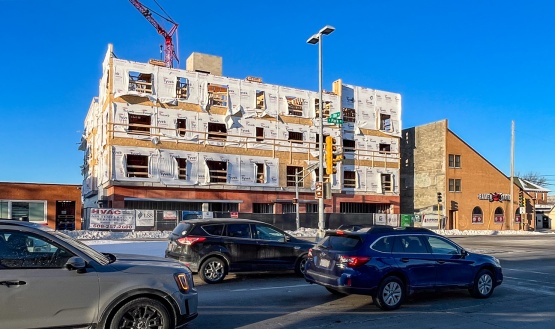
With financial support and land donation from the City, Eminent Development Corporation is building this 44-unit mixed use building on South Park Street with a subset of rental homes reserved for youth that are aging out of the foster care system. -
Individuals Experiencing Homelessness
- Based on consistent “point-in-time” counts, the number of people facing homelessness in 2025 was near 800, very close to that of 2015. The number of single adults has increased significantly over the past decade.

These townhomes under construction on Ellis Potter Court off of Schroeder Road will house families, but are part of a larger affordable housing development by Horizon Development Group and JW Realty Investments with financial support form the City. The development will include homes reserved for families, older adults, veterans, people with disabilities, and people who have recently experienced homelessness.