
Maintaining a Healthy Tree Canopy in Madison’s Parks
postedOak Wilt is a disease caused by a fungus that attacks oak trees, causing them to wilt and die. Species in the red oak group are particularly vulnerable to this disease and usually die within months of becoming infected. Sap-feeding beetles are known to spread the fungus from infected trees to fresh wounds on healthy trees in new areas. In addition, once a tree is infected, the fungus spreads quickly through the roots to other nearby oaks. One dead tree becomes a cluster of dead trees, continually expanding outward.
Parks staff discovered Oak Wilt at Meadow Ridge Conservation Park in the summer of 2026. A few dead red oak trees were surrounded by several that showed the tell-tale “flagging" with brown, wilting leaves that have now fallen prematurely. Samples from three trees were tested by the UW Extension Plant Disease Diagnostics Clinic, which confirmed these trees were infected with Oak Wilt.

Unfortunately, there is no cure for Oak Wilt, so treating or removing an infected tree will not stop the spread of the disease underground. Instead, it must be contained by proactively removing healthy trees around the infestation. Following the Oak Wilt Management guidance provided by the Wisconsin Department of Natural Resources, Parks staff assessed trees throughout Meadow Ridge, which is heavily dominated by red oak. They measured the diameter of each tree and assessed whether its roots could be connected to those of an infected tree through root grafting, which occurs when roots of two trees grow together and form an underground connection. Trees that were closely connected underground to infected trees were marked, girdled, and treated with herbicide to quickly kill the roots of those trees. Girdling removes a ring of bark and inner cambium layer which stops nutrients from reaching leaves and eventually kills the tree. The DNR Forest Health Specialist confirmed that our containment plan is appropriate and necessary.

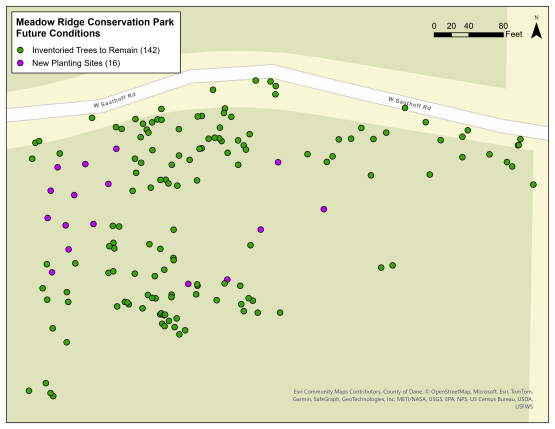
Some healthy red oaks in the middle and on the edges of the containment area were evaluated by staff and by an independent arborist who specializes in tree health. These trees could be treated with a special fungicide that suppresses the Oak Wilt fungus. If they are already infected, fungicide will prevent them from dying. This would be sustained until new trees – white and bur oak – can be planted and become established to preserve the oak woodland habitat here. Girdling is happening this fall, and many of the dead trees will be removed this winter. Some will be left standing for habitat. In 2027, staff will work hard to control invasive species on the site, such as Asian bittersweet, garlic mustard, and hedge parsley. Then in 2028, Parks staff will begin planting saplings. In fall 2027 and beyond, staff will continue to collect and plant acorns as well. The multi-year effort will ensure a sustainable population of oaks of various ages.
Staff began an inventory of all trees at Meadow Ridge Conservation Park. To date, 230 trees have been inventoried. Areas not yet inventoried are dominated by red oak as well.
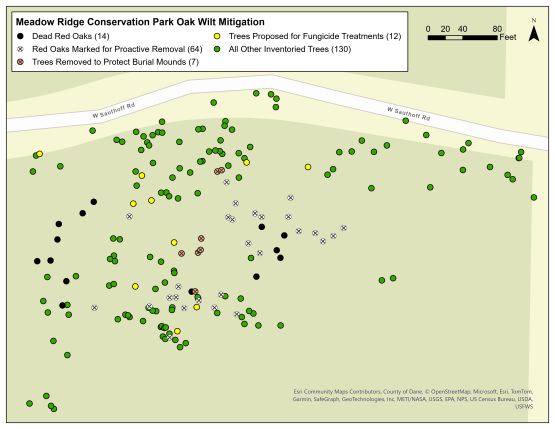
A total of 65 red oak trees need to be proactively removed to contain oak wilt. Twelve trees will be treated with fungicide next summer if they are still healthy. In addition, seven trees (5 red oak, 1 hackberry and 1 black cherry) will need to be removed to protect a burial mound. Crews will do that work at the same time this winter.

This content is free for use with credit to Madison Parks.