
Zero Waste
Creating a Circular Economy
Many products and materials only get one shot at usefulness, traveling in a linear fashion from production to consumption and then end up in a landfill or incinerator. A circular economy aims to change this paradigm by keeping materials, products, and services in circulation for as long possible. And by recovering raw materials after the lifetime of products for their next use, a circular economy produces zero waste.
A circular economy reduces greenhouse gas emissions, protects the environment, provides economic resilience, and advances environmental justice by reducing the negative environmental and health impacts caused by a non-circular economy that disproportionately impact low-income communities and communities of color.
The City of Madison is working with partners across our region to help grow a circular economy, deliver programs to end food waste, support recycling, and invest in business and research. The City of Madison is partnering with Dane County to create the Yahara Hills Sustainability Campus to help advance a circular economy for our community. The Sustainability Campus will serve as a hub for reuse, repair, and recycling businesses; implementation of new waste management technologies; and research and innovation. The campus will also be open to the public for education and recreation. Visit the project page to learn more about this exciting new collaboration.
Our Plan to End Food Waste

According to the U.S. Department of Agriculture (USDA), 30 to 40% of food is wasted in the United States. That's food that could help feed families and contribute to the wellbeing of our community. According to the Wisconsin Department of Natural Resources, 20.5% of our landfills consist of food, making food waste the largest component of our waste stream. Once in our landfill, organic material like food scraps decompose and create methane, a very potent greenhouse gas, and the nutrients that the food could return to the soil to support future agriculture production are lost.
The City of Madison has a plan for ending food waste in just four easy steps. Check out the Plan. Use. Create. Scrap. resources provided by the Streets and Recycling Division to learn how you can avoid food waste.
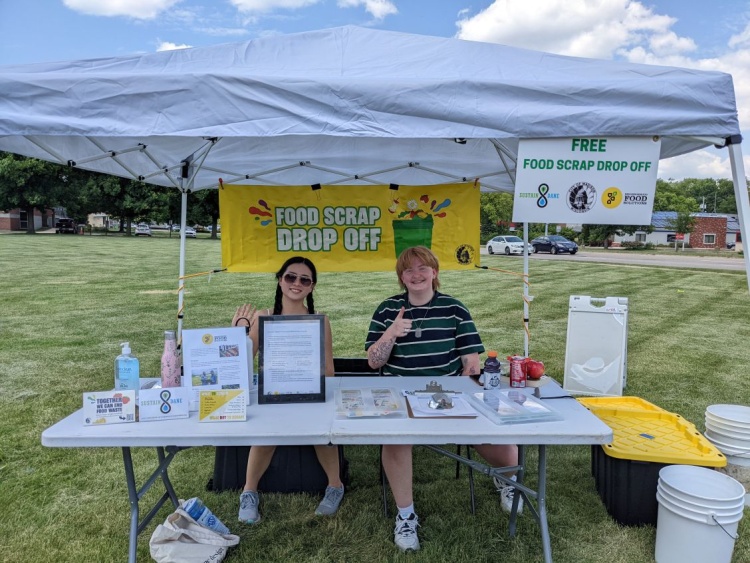
Farmers' Market Food Scrap Drop Off
You can participate in the circular economy by dropping off your food scraps at four local farmers' markets starting again in April 2026. The program is free and open to the public for all households in Madison. Visit Sustain Dane to learn more about what types of food can be dropped off for composting, how much food waste has been collected so far, and how you can volunteer.
Westside Community Market
- Saturdays at 7:00am to 12:30pm, April 11 to October 31
- 505 South Rosa Road in the parking lots of the MG&E Innovation Center.
- If inclement weather, check the Westside Madison Farmers’ Market social media to see if market is canceled.
South Madison Farmers’ Market
- Tuesdays at 2:00pm to 6:00pm, May 19 to October 27.
- 1602 South Park Street on the grounds of the Madison Labor Temple
- If inclement weather, check the South Madison Farmers’ Market social media updates to see if market is canceled.
- Parking available on Wingra Drive for food scraps drop off and shopping at market.
Eastside Farmers’ Market
- Tuesdays at 4:00pm to 7:00pm, April 28 to October 27
- 202 South Ingersoll Street at McPike Park
- Market will be open rain or shine. See Eastside Farmers’ Market social media updates.
Capitol View Farmers' Market
- Wednesdays at 3:00pm to 7:00pm, May 27 to October 14
- 5901 Sharpsburg Drive near City View Park
- If inclement weather, check the Capitol View Farmers’ Market social media updates to see if market is canceled.
Farmers' Market Food Scrap Collection is a collaborative effort with partners Sustain Dane and Neighborhood Food Solutions (NFS) farm.
Recycling

Recycling is another key way to keep materials out of the landfull, reduce consumption of raw materials, and help our environment. The City of Madison's Streets Division provides information, resources, and services to make recycling easy.
The Recyclopedia is your comprehensive resource for learning what can be recycled in Madison, how curbside recycling collection works, and which types of items need to be dropped off at City or County collection sites, such as electronics and large items.
Recyclables collected by the City of Madison Streets Division has too much trash in it. Approximately 13% of all the material collected from the green carts is actually trash that should not be there. By the end of 2021, we had over 2,000 tons of trash in our recyclables. We can certainly recycle better. And you can help.
In your own cart, be sure you are recycling right by following the Streets Division guidelines that you can find online at Recycling Guidelines, in the Recyclopedia, in our flyers, and maybe even on your refrigerator or the lid of your recycling cart.
Recycle Better Program
Do you still have questions about what can be recycled? Level up your recycling skills by taking the Recycle Better course. The City of Madison has partnered with Sustain Dane and the Latino Academy of Workforce Development to create a fun, two-session class that teaches you how to make the most of our local recycling system and gives you the tools to share your knowledge with your friends, family, neighbors, and coworkers.
For more information and to sign up for a course in English or Spanish, visit Recycle Better page on Sustain Dane's website.