
Playground Replacement Program
Madison owns and maintains about 190 playgrounds, excluding most school sites managed by Madison Metropolitan School District (MMSD). This equates to 7 playgrounds per 10,000 residents, keeping Madison in the "Top 10" of the Trust for Public Land’s national municipal parks ranking. While proud of this achievement, maintaining such a large, safe, and accessible system incurs significant costs.

Standard Post & Platform Playgrounds
Post and platform refer to modern playground equipment consisting of posts and platforms which are interconnected by various play elements such as stairs, bridges, ramps, etc. These playgrounds are meant to serve the surrounding neighborhood in which they are located. The expected lifespan of post and platform playground equipment is about 20-30 years.
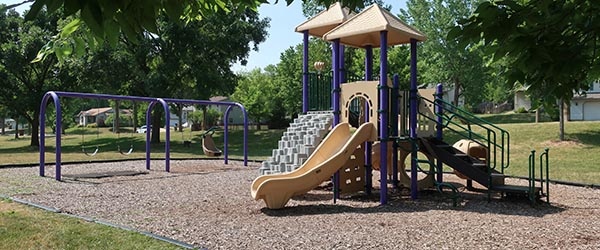
Community Parks
- One playground structure with 2–5-year-old sized equipment
- One playground structure with 5–12-year-old sized equipment
- Swings
- Often standalone play elements, as budget allows
Neighborhood and Mini Parks
- One playground structure, either 2–5-year-old or 5–12-year-old
- Parks staff work with community residents to determine the age range of the structure
- Swings
- Often standalone play elements, as budget allows
Accessibility Components
Included in all replacement projects, when feasible
- A paved, accessible path to the playground from the street sidewalk
- A transfer station included in the playground equipment
- Fencing between the street and playground when necessary
- Inclusive swing seats upon request, so long as site conditions allow
Playground Surfacing
A critical component of managing public playgrounds to ensure safety in the surfacing. It is a major part of the safety audit process and our primary focus in this evaluation is on impact attenuation to meet critical fall height standards. The Consumer Product Safety Commission’s Public Playground Safety Handbook provides standards for playground surfacing. Madison Parks offers the following surfacing options:
- Standard Playgrounds
- Wood Mulch
- Rubber Mulch
- Nature-Based Play
- Wood Mulch
- Pea Gravel (provided fall heights are less than 5 feet)
- Inclusive Playgrounds
- Poured-in-place rubber surfacing
Note: Some of the older playgrounds remaining in the park system still utilize surfacing other than what is noted. Those playgrounds are planned to receive new surfacing when they are due for replacement.
Accessible Playgrounds

In partnership with the Madison Parks Foundation, Madison Parks has constructed four accessible playgrounds. The playgrounds utilize poured-in-place rubber surfacing and accessible routes from adjacent sidewalks, paths, and vehicle parking areas. The play equipment is selected for inclusive features such as ramps or barrier-free at-grade access. These playgrounds are also designed to serve a larger geographical area than standard playgrounds
Accessible playgrounds typically cost about five times more to construct than standard playgrounds, which limits the number of inclusive playgrounds the Parks Division can provide.
Nature-Based Play
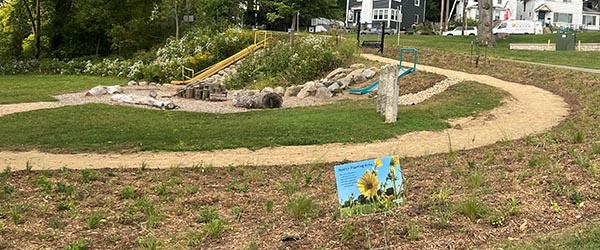
The City of Madison is a Nature Everywhere Community. Madison Parks has implemented numerous full nature-based play areas as well as including logs or boulders into standard playground designs when neighborhoods show an interest. In some situations, aged standard playground features have been removed and nature-based elements put in their place. New nature-based play areas are typically identified in Park Master Plans (Community parks) or Park Development Plans (Neighborhood and Mini parks) prior to design and construction.
History of Playground Replacements in Madison Parks
In the 1990s, playgrounds shifted from inaccessible wood structures to safer, ADA-compliant equipment, typically topped with crumb rubber or pea gravel. By 2012, many playgrounds neared the end of their lifespan, prompting the Parks Division, Alders, the Mayor, and the Board of Park Commissioners to develop a program to replace more than 120 playgrounds from 2013 onward. Adopted as RES-13-00034 (Legistar File 27854) this plan prioritized replacements based on safety, age, and condition, with standardized equipment, a yearly capital budget, and neighborhood contribution guidelines.
Parks staff follow a schedule aiming to replace all playgrounds within 20–30 years, which matches the expected playground lifespan, and adjusting the replacement schedule for safety issues or deteriorating conditions. Annual replacement numbers vary due to fluctuating costs and funding availability, with staff regularly reviewing and revising the schedule as needed.