
Let's Talk Budget: 2027 Hola ERIP

posted 

What is ERIP?

The Expenditure Restraint Incentive Program (ERIP) is a state rule that limits the amount by which cities can increase spending each year. 

  • If we stay below the limit, we will keep about $7 million to $9 million in state aid
  • If we go over the limit, we lose $7 million to$9 million in state aid

How is ERIP calculated?

ERIP - Madison's 2025 Budget Limits

The 2026 budget includes $9 million in ERIP funding.
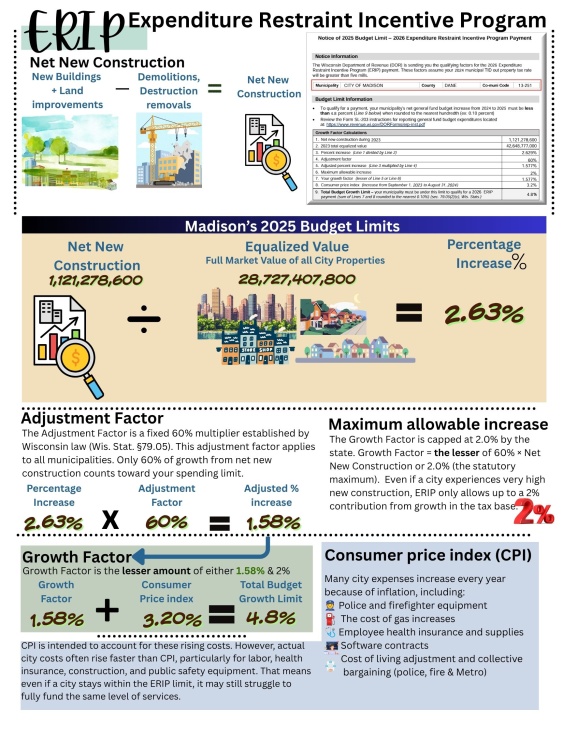
ERIP 2025 Calculation

ERIP 2025 Calculation

Why is this a challenge?

State law limits property tax levy growth mainly to new construction. It doesn't keep up with inflation or the rising cost of services.

For 2027, the City's projected Cost to Continue is $7.2 million above the ERIP limit, making expenditure reductions necessary unless state law changes. Estimated growth limit for 2027 = 4.6%

Cost to Continue 

  • The funding needed in the coming calendar year to maintain the same level of city services provided in the current year. 
  • It reflects the increased cost of continuing existing services, which includes wages, employee benefits, fuel, utilities, and contractual costs
  • It is not the cost of expanding services or meeting every unmet need across the city.

The cost of the continued estimate for 2027 is $483.2 million.

erip rev 2027
  • Wages & Benefits

    When we talk about the cost of city services, we're primarily talking about the people who provide those services. Police officers, firefighters, librarians, snowplow operators, engineers, bus drivers, parks staff, planners, and many others are the workforce that keeps the city running every day.

    • + $9.7m: Salary + benefits increases in 2027
  • Healthcare

    Rising health care and insurance costs increase the expense of providing benefits for the employees who deliver city services. City employees pay a significant portion of the health insurance; the city doesn't provide full cost coverage.

  • Fuel

    Higher fuel prices impact all of us as individuals. At the city level, the cost of gas increases the operating costs of snowplows, buses, fire trucks, police vehicles, garbage trucks, and other city equipment.

    • +$1.5m: Fleet charges, primarily for increased fuel costs
  • Non-Personnel Costs

    Half of the increase for software costs ($1.3m). Library contract with Dane County ($289,000), legal services and consulting for property tax challenges ($225,000), building maintenance costs ($170,000), and other expenses.

  • Emergency services and prevention

    Providing public safety includes not only police, fire, and EMS, but also preventive services such as libraries, violence prevention programs, the CARES program, access to transit, and community development initiatives that help address problems before they become emergencies.

    • + $9.5m: Metro subsidy increase

Steps Madison took before this year to balance the Budget

Before considering reductions required under ERIP, Madison had already implemented numerous budget-balancing measures over many years, including:

  • Using one-time funding sources, including fund balance, debt premiums, TIF closures, and federal ARPA funds during and after the pandemic.
  • Reducing spending, including agency reductions, workshare programs, furloughs, vacancy savings, and operational efficiencies.
  • Shifting costs away from the General Fund, including moving the Overture Center, Henry Vilas Zoo, Olbrich Gardens, and Alliant Energy Center to room tax funding; moving library collections to the Capital Budget; shifting parking enforcement to the Parking Utility; and reallocating forestry staff costs to the Urban Forestry Special Charge.
  • Creating or increasing dedicated fees, such as the Urban Forestry Special Charge, Resource Recovery Special Charge, Vehicle Registration Fee, ambulance fee increases, building permit revenues, and room tax increases.
  • Making targeted service adjustments, including reducing the snow and ice removal budget assumptions and finding efficiencies across departments.
  • Using federal pandemic relief funds to temporarily maintain service levels while avoiding deeper cuts during COVID-19.

2027 Budget Guidance

The 2027 budget instructions asked departments to maintain essential services while operating within tighter financial limits. Agencies were directed to find efficiencies, identify potential reductions, avoid requesting additional funding or new positions, and use data to demonstrate the impact of their services.
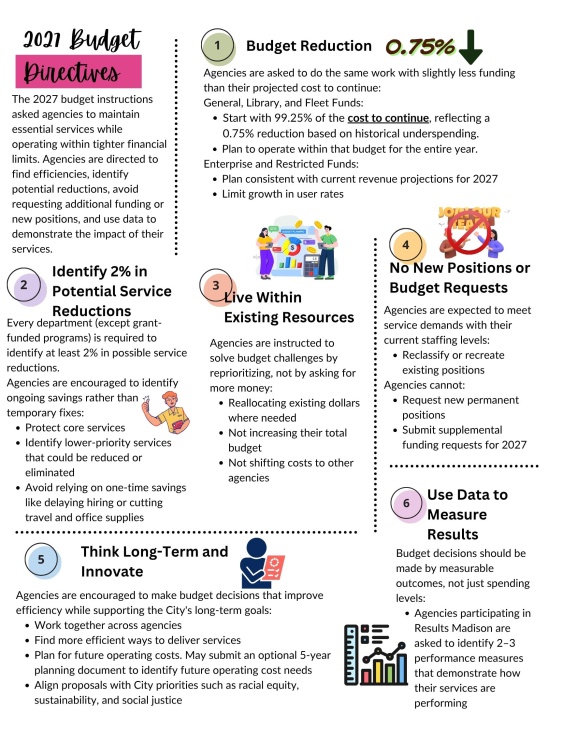
2027 Budget Directives

Budget Reduction

Agencies are asked to do the same work with slightly less funding than their projected cost to continue:

General, Library, and Fleet Funds:

  • Start with 99.25% of the cost to continue, reflecting a 0.75% reduction based on historical underspending.
  • Plan to operate within that budget for the entire year.

Enterprise and Restricted Funds:

  • Plan consistent with current revenue projections for 2027
  • Limit growth in user rates

Identify 2% in Potential Service Reductions

Every department (except grant-funded programs) is required to identify at least 2% in possible service reductions.

Agencies are encouraged to identify ongoing savings rather than temporary fixes:

  • Protect core services
  • Identify lower-priority services that could be reduced or eliminated
  • Avoid relying on one-time savings like delaying hiring or cutting travel and office supplies

Live Within Existing Resources

Agencies are instructed to solve budget challenges by reprioritizing, not by asking for more money:

  • Reallocating existing dollars where needed
  • Not increasing their total budget
  • Not shifting costs to other agencies

No New Positions or Budget Requests

Agencies are expected to meet service demands with their current staffing levels:

  • Reclassify or recreate existing positions

Agencies cannot:

  • Request new permanent positions
  • Submit supplemental funding requests for 2027

Think Long-Term and Innovate

Agencies are encouraged to make budget decisions that improve efficiency while supporting the City's long-term goals:

  • Work together across agencies
  • Find more efficient ways to deliver services
  • Plan for future operating costs. May submit an optional 5-year planning document to identify future operating cost needs
  • Align proposals with City priorities such as racial equity, sustainability, and social justice

Use Data to Measure Results

Budget decisions should be made by measurable outcomes, not just spending levels:

  • Agencies participating in Results Madison are asked to identify 2–3 performance measures that demonstrate how their services are performing

Let's Talk Budget: 2027 Hola ERIP-PDF Format

Categories:

Was this page helpful to you? * required
Portrait of Alder Yannette Figueroa Cole

Alder Yannette Figueroa Cole

District 10
Contact Alder Figueroa Cole

Categories