Let's Talk: To the Extent Permitted by Law

posted 

To the Extent Permitted by Law

You may have heard multiple interpretations about the authority the Council intended to give the Office of the Independent Monitor and the Police Civilian Oversight Board when the 2020 Council created Madison General Ordinances (MGO) 5.19 and 5.20.

There is a lot that the ordinances do not say when it comes to clearly and explicitly putting that intent into writing. That lack of clarity has created contention and noise at all levels of the City. But today's arguments are not new. If you go back in time, many of these same concerns were discussed and left unresolved in 2020.

One statement in the ordinance, however, is clearly stated: access to records and subpoena power are provided "to the extent permitted by law."

We have often heard about OIM's access to records and subpoena power in incomplete sentences that ignore the part stating this authority is limited by state and federal law.

(i) Access MPD Records. The OIM shall, to the extent permitted by law, have unfettered access to all MPD records, policies, Standard Operating Procedures, data, computer databases, and other information necessary to fulfill the duties of the OIM.

(j) Issue Subpoenas. The Monitor may, to the extent permitted by law, issue subpoenas for the purpose of compelling testimony or receiving documents necessary to fulfill the duties of the OIM.

MGO 5.19(7) Powers and Duties of the OIM and Monitor

In 2020, Attorney Haas explained some of the limitations on this access in an informational memo sent to all alders. This week, he released an official legal opinion addressing the interaction of multiple state and federal laws with MGO 5.19, MPD's SOP, and the MOU.

The Formal  Opinion No. 2026-001 includes the August 2026 legal opinion and the supporting documents, including the 2020 memo and the MOU.

To help me process the information, I divided the legal opinion into two separate topics:

  1. The laws governing Officer-Involved Death investigations
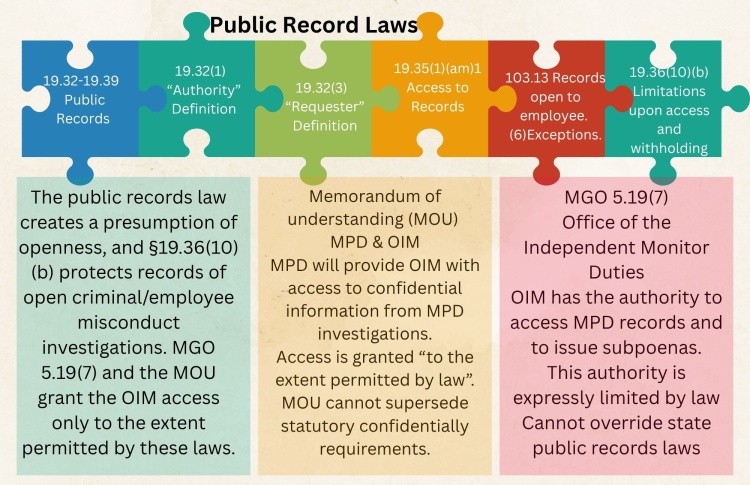
  2. The Public Records laws that protect information related to those investigations

Officer-Involved Death investigations are inherently complicated. They are structured to protect evidence that could ultimately be needed in a criminal case.

The Public Records laws create a balance between the public's interest in having access to information and the need to maintain the integrity of an investigation by limiting how and when investigative information can be released.

I am not a lawyer, and I am not in the position to argue with a City Attorney's legal opinion. I can read and track the sources supporting the legal opinion. So I read the legal opinion, tracked the laws used to support the argument, tracked the statutes, and read the referenced sections of the law.

Then I compared the City Attorney's interpretation of the law with the actual language of the statutes to help me follow his logic. I organized the information in a way that was easier for me to digest. I can tell the attorney put great effort into writing this memo in plain language, which helped me create the visuals shared in this blog. 

I hope these visuals provoke curiosity and encourage you to do your own reading and research, helping you feel empowered to verify claims instead of relying on social media posts from individuals with zero legal authority. My goal is not to tell you what conclusion to reach, but to provide a starting point to help all of us better understand the laws, the ordinances, and the different layers of authority involved, and ultimately help us make informed statements.


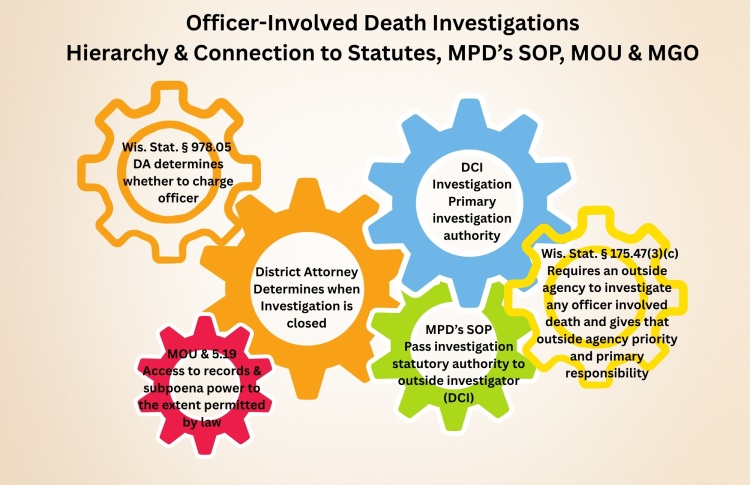
Officer-Involved Death Investigations Hierarchy & Connection to Statutes, MPD's SOP, MOU & MGO
hierarchy

Officer-Involved Death Investigations: Hierarchy & Connection to Statutes, MPD's SOP, MOU & MGO

State & City Laws

Please click this link to view a couple of Visio charts showing how the City & State laws work together, along with the Attorney's interpretation of the Public Records law next to the actual Statutes' language.  State City Laws Combined And Public Record State.pdf(opens in a new window)PDF

Public Record Laws

puzzle ord

Public Record Laws


Legal Entities

As for the different layers of governance in an Officer-Involved Death Investigation and Legal Process, I am also sharing a high-level overview of the processes involved, from DCI criminal investigation to a potential Police & Fire Commission (PFC)'s statutory disciplinary proceeding, which includes an initial hearing and an evidentiary hearing. Based on Wis. § 62.13 (5)b which governs the PFC, "Charges may be filed against a subordinate by the chief, by a member of the board, by the board as a body, or by any aggrieved person."

The Madison General Ordinance (MGO) that establishes the PFC is 33.06 and states that: "The Board of Police and Fire Commissioners for the City of Madison shall consist of five (5) citizens, appointed by the Mayor and approved by the Common Council. The Board shall have the power and authority conferred under the provisions of Subsections(1), (2), (3), (4), (5), (5m), and (7) of Section 62.13"

Wis. § 62.13 Police and fire departments: the following subsections apply to MGO 33.06:

(1) Commissioners. 5 citizens, 3 of whom shall constitute a quorum

(2) Exception. List of exceptions to the formation of a Board

(3) Chiefs. Board appoints the chief of police and the chief of the fire department

(4) Subordinates. The chiefs shall appoint subordinates subject to approval by the Board.

(5) Disciplinary actions against subordinates. The Board can suspend, reduce, or remove individuals. Individuals can also appeal the decision. Defines process for complaints, hearing and appeal.

(5m) Dismissals and reemployment. Because of need for economy, lack of work or funds, or for other causes

(7) Compensation. The council shall fix the salaries of chiefs and subordinates. Such salaries, when so fixed, may be increased but not decreased by the council without a previous recommendation of the Board.

I will leave this research for you to do. I'll revisit it as the investigation progresses.
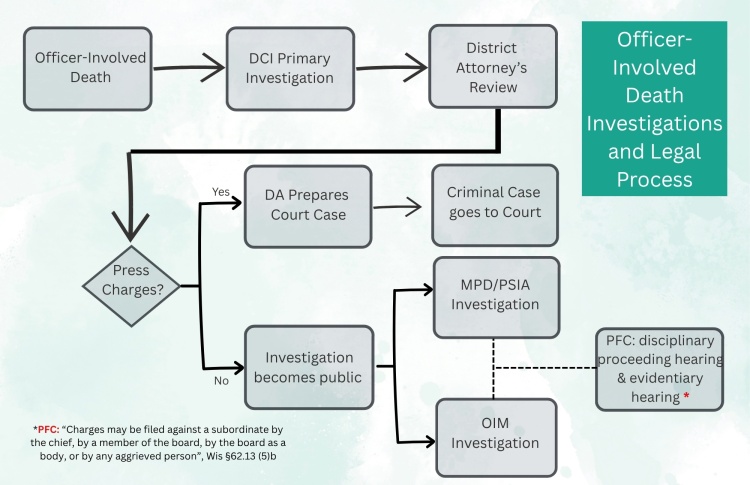
Investigation Flow

Categories:

Was this page helpful to you? * required
Portrait of Alder Yannette Figueroa Cole

Alder Yannette Figueroa Cole

District 10
Contact Alder Figueroa Cole

Categories