
2027 Operating Budget – A $7.2 Million Challenge
postedA Sobering Budget Message
On Monday, June 29, Finance Director Dave Schmiedicke reviewed the current prognosis for the 2027 operating budget during the Finance Committee meeting and described the guidance the Mayor's Office is giving all departments as they prepare their initial budget requests due July 17. Director Schmiedicke will reprise that presentation for the full Common Council this week on Tuesday, July 7 (Item 3, Legistar 93677).
The annual operating budget process begins with an estimate by the Finance Department of the “Cost to Continue", that is, the expenditures necessary in the coming calendar year to deliver all of the services approved and provided for in the current year. Director Schmiedicke's report describes some of the nuances in estimating the Cost to Continue, which is estimated to be $483.2 million.
Wisconsin statutes place limits on the amount by which both revenues and expenditures can increase each year. For 2027, it is the expenditure constraint which presents a serious challenge. Madison must decide how to reduce expenditures by $7.2 million to remain within the state guideline. To accomplish that, services currently available may need to be cut. The Mayor's Office has provided guidance to all departments on how to limit their requests and propose specific service reductions.
The Wisconsin Revenue and Expenditure Limits
Wisconsin limits the annual increase in tax levy to the net increase in new construction value with no allowance for inflation. That rule has resulted in a growing “structural deficit" over the past dozen years which Madison was able to sidestep with a variety of measures until 2024. In preparing the 2025 operating budget the City faced a $22 million deficit, leading to a levy increase referendum that November. Voters approved the referendum, allowing the 2025 budget to go forward without draconian cuts in services.
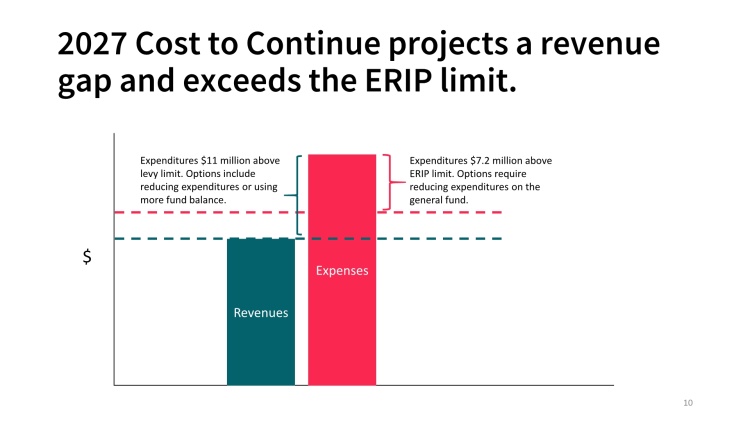
The inherent force behind the structural deficit did not disappear with the referendum. However, in formulating the 2025 operating budget the city also approved a first ever five-year operating budget plan, which urged managing the structural deficit by gradually drawing down Madison's “rainy day fund" for at least the next five years rather than looking to regular referenda. Behind that plan was the hope that our state would eventually need to reform the levy limit formula, increase revenue sharing, and even give cities some of the sales tax authority granted to Milwaukee. The estimated levy limit for 2027 is $11 million less than the Cost to Continue.
Wisconsin's “Expenditure Restraint Incentive Plan" or “ERIP", has a nice ring but is an effective limit on municipal expenditures. If Madison's operating budget increase exceeds a state calculated inflation measure, our city loses $5 to $7 million in state funding. For years since the passage of the ERIP program, it was the levy limit that created our Madison budget challenges. That changed last year with the development of the 2026 operating budget when Madison had just $200,000 to spare before hitting the ERIP limit. For 2027, the cost to continue is $7.2 million over the ERIP cap.
We can plug the levy limit gap with $4 million from the “rainy day fund", but the only way to stay within the ERIP limit is to strip $7.2 million from the Cost to Continue.
Guidance to Agencies from Office of the Mayor
At this early point in the budget process the Cost to Continue is built from many estimates. As we learn more about the pace of inflation and revenue from non-tax sources, it could increase or decrease. Nevertheless, in the absence of some unanticipated financial miracle, we know we are facing a serious challenge. In response, the Office of the Mayor has provided the following instructions to all agencies.
- All agencies must submit their recommendation for how to reduce their Cost to Continue by 2%.
- Assume that employee turnover will reduce full staffing costs by 3% (actually ranging from 0% to 4% depending on agency size) and don't include this savings in the 2% haircut.
- The general, library, and fleet funds need to include a 0.75% efficiency savings.
- No new staff positions.
- No supplemental requests – meaning no new programs or initiatives unless funded with transfers from existing programs and initiatives.
- Unlike previous budgets, the mandates on reductions and supplemental requests also apply to enterprise and restricted funds, that is, operations funded by fees and other income sources than property tax revenues, such as the water and sewer departments. Affordability is a general problem, and we need to find savings in all activities.
- Agency requests should be aligned with citywide priorities, including racial equity, social justice, and sustainability.
- Agencies should prioritize creativity and innovation that reduces the cost-of-service delivery, that is finding service delivery system changes that deliver the same service for lower cost.
- The Executive Budget in October will include 2 to 3 service metrics for each agency that has completed the Results Madison data engagement.
Get Involved – Final Public Engagement Meeting July 16
The last of three budget engagement sessions will take place in District 19 at Vel Phillips Memorial High School, 201 S Gammon Rd, on July 16 from 6:00 to 8:00 pm. You can register here. We'll have pizza and drinks.
For the first hour open house, you can chat with staff at tables for the various public facilities and services departments:
- Assessor
- Clerk
- Engineering
- Fleet
- Human Resources
- Information Technology
- Library
- Monona Terrace
- Parks
- Streets and Urban Forestry
- Water Utility
After the open house, Finance Director Dave Schmiedicke will make a short presentation on the budget process. That will be followed by a Q&A session with alders. You don't need to confine your questions to the presenting departments. We want to hear your ideas on budget priorities.