
New Population Growth Estimates
postedCapital Area Regional Planning Commission Releases Its Own Population Projections
On Thursday, November 20, I participated in a videoconference hosted by the Capital Area Regional Planning Commission in which a Regional Development Group (RDG) sponsored by the Commission presented independent estimates of population growth for Dane County and its towns and municipalities (Link to Presentation).
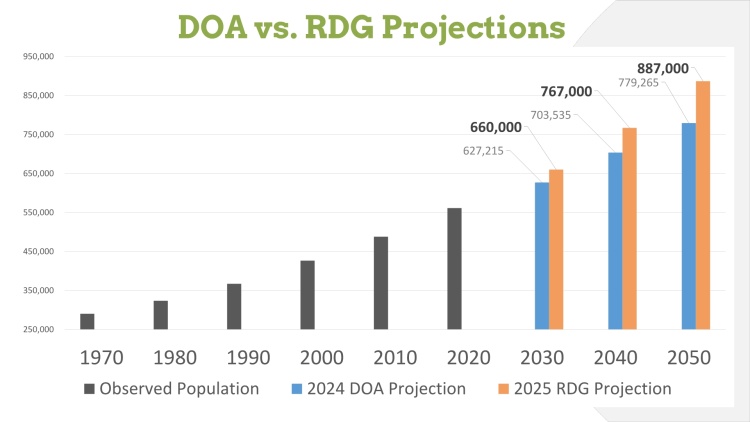
Wisconsin’s Department of Administration (DOA) has released population growth estimates every five years since 1978. They have consistently underestimated the future population of Dane County and Madison in particular. DOA’s 2024 population projections appear to be too conservative just one year into the period. Population projections are important for long-range planning for cities, counties and school districts. They are particularly important for housing policy, hence the motivation to independently assemble forecasting experts to take a closer look at Dane County.
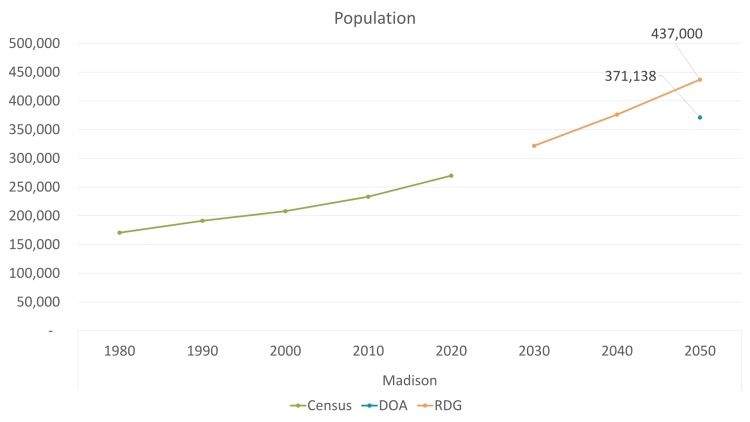
What the RDG experts found was that DOA has generally calculated future population by fitting a linear (straight line) trend to historical data. RDG found that a quadratic formula better fitted the actual trends, meaning that the pace of population growth isn’t constant but is accelerating a little over time.
RDG vs DOA projections
| Jurisdiction | RDG 2050 Estimate | DOA 2050 Estimate | Difference |
|---|---|---|---|
| Dane County | 887,000 | 779,265 | 107,735 |
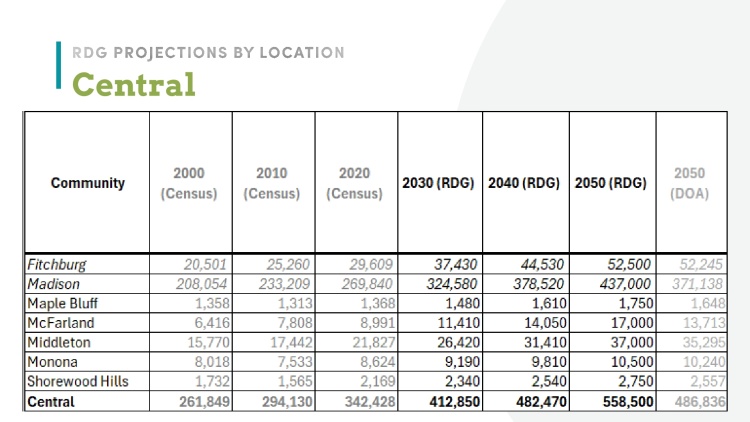
| City of Madison | 437,000 | 371,138 | 65,862 |
These are big differences, with significant implications for County and City policies. Here is a little more detail in two charts and a spreadsheet.
What Could Change?
The RDG report dives into factors that impact population growth and how changes in those factors could yield very different results. These factors include assumptions about birth rates (it’s been declining), household size (also declining), net immigration and employment trends. An interesting characteristic of Dane County is that it is the only Wisconsin county in which the Gen-Z population outnumbers the elderly cohorts. Another consideration is how successful Dane County and its municipalities manage this growth. In Madison, if we fail to meet our goals for new housing, home prices and rents will continue to climb precipitously, pushing people to the outer ring of Dane towns or to neighboring counties.
Whatever actually happens, the central conclusion is that Madison and Dane County will continue to grow and need to manage the problems that growth brings, while most of Wisconsin will endure the problems inflicted by population decline.