
Update on the Proposed $2.4M Harm Reduction Day Shelter: Process, Transparency, and What Comes Next
postedHello neighbors,
This afternoon I’m sharing a brief—but important—update on the proposal from CAYA that would add a harm reduction day shelter in the East Towne area.
Because there is a significant amount of information and it can quickly become overwhelming, this update is organized as a recap. I will also share what I’ve learned in a YouTube video later this evening to help walk through these issues in a more conversational way. (I’ll update this post with the link once it’s ready.)
Board of Health Meeting Update
First, I want to share an important procedural update.
The Board of Health (BoH) meeting scheduled for Wednesday, January 14 initially did not include a hybrid (virtual) option. After myself and others raised concerns, a hybrid option has now been added.
Please also note:
- This meeting is now a public hearing only
- No vote will be taken at the January meeting
- A vote is now expected at the February Board of Health meeting
- There will be no public comment at the February meeting
Because of that, it is especially important that community members who wish to share their perspectives register to speak at the January meeting. I plan to attend in person.
You may also email comments to me at district17@cityofmadison.com, and I will ensure they are shared with the Board of Health.
Meeting Details:
- Wednesday, January 14, 2026
- 5:30pm
- Location: You can attend this meeting virtually or in person.
- Public Health Madison & Dane County
210 Martin Luther King Jr. Blvd., Room 357
Madison, WI 53703
- Public Health Madison & Dane County
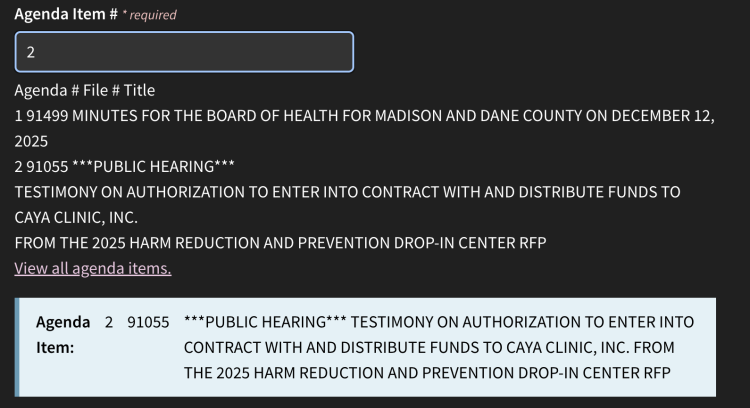
- Agenda
- You can also send public comments to phbohsupport@cityofmadison.com. Please note that if you'd like me to see your comments, you'll need to Cc me on the email at district17@cityofmadison.com .
- Register to speak.
The Core Issue
To better understand the concerns that Alders Field, Matthews, and I have raised, I strongly encourage you to review my earlier blog post, which includes the letter we shared with County leadership outlining our concerns and specific requests.
I want to reiterate the following clearly:
We support harm reduction as a public health strategy. However, the placement and operation of harm reduction sites need to be planned carefully and with consideration for the supports that are essential to making them successful. Support for harm reduction does not mean support for any proposal, in any location, advanced through any process without question.
My concerns began when I first learned about the lack of proactive planning to open a day shelter. As I reviewed the Request For Proposals (RFP) that would provide $2.4M over three years and CAYA’s proposal more closely, those concerns deepened.
What Has Happened Since My December 18th Blog Post
Since sharing that blog post and letter:
- Madison365 published an article outlining the concerns surrounding the proposed harm reduction day shelter.
- It has since been confirmed that County Supervisor Rick Rose is employed by CAYA. According to Madison365, Public Health Madison & Dane County (PHMDC) stated they were unaware of this relationship until they requested the agency’s staff roster.
- I met with some members of the Board of Health and learned that:
- They had not read the RFP details
- They had not read the applications
- Yet they were being asked to vote on funding CAYA
- They were also unaware that a County Supervisor worked for the agency they were expected to vote on to fund.
- I learned early on that Board of Health members did not have access to the applications prior to an expected vote back in mid December. (This was the meeting I attended and the item was tabled)
- I advocated multiple times for those applications to be shared
- It is my understanding they only received them last week, not when first requested
- Despite asking the BoH directly for copies, I received only CAYA’s application from the director
- I obtained the other applications only after filing a public records request
The Day Shelter Issue
Despite my repeatedly stating that the proposed harm reduction drop-in center functions as a day shelter, CAYA staff publicly disputed this characterization.
A CAYA staff member stated: “I wouldn’t call it a day shelter.”
However, the City’s Zoning Administrator shared with me:
“Everything I’ve seen thus far points to this being classified as a ‘daytime shelter’ under the zoning code.”
That PHMDC, County Supervisors, Opioid Settlement Fund Committee members, and County staff did not proactively plan with the City to open a day shelter is a serious issue that should not be overlooked.
When we refer to a space as being a day shelter, this is not labeling the space in the negative. They simply require additional planning, coordination, and resources, especially in the East Towne area. This is why in our letter, we ask for resources and additional planning.
It is also important to say plainly: Alders and City staff should have been at the table when this RFP was drafted.
Several Alders already host shelters in our districts. We understand both the opportunities and the challenges, and we see ourselves as resources—not obstacles. Being excluded from early planning was a flaw in the process that I hope will be corrected moving forward.
What I Learned From Other Applicants
I reached out to the other applicants and learned that:
- Communication from PHMDC was poor
- They were unclear about where they stood in the process
- They did not receive additional guidance or assistance from PHMDC/County prior to submitting their proposals
This matters because fairness and consistency are foundational to any credible public funding process.
Communication With County Leadership
I did eventually hear back from County Supervisor Tommy Rylander last week. He shared that:
- He was unaware of the RFP
- He was unaware that Supervisor Rose was employed by CAYA
- He had no knowledge of many of the concerns raised in the letter I shared
This raises an important question:
Why was the County Supervisor whose district would host this facility not meaningfully included earlier in the process?
Supervisor Rylander later apologized to me for contacting me to discuss both CAYA and his own election related questions after not responding to my outreach in mid-December. I shared that I found this frustrating—and I continue to find so much of what I've learned to be concerning.
Questions That Remain Unanswered
There are still significant questions that deserve answers:
- Did committee members who scored the applications know that CAYA did not currently have BIPOC staff and had not been able to retain Black staff?
- Were they aware that a County Supervisor was employed by one of the applicant agencies?
- Were they aware that this same County Supervisor chaired the Opioid Settlement Fund Committee?
- Were they aware of his role in the legislative history tied to the funding CAYA may receive?
- Were those who wrote letters of support aware of these undisclosed relationships?
- Were they aware that the application identified “BIPOC staff,” which CAYA later stated was included in error?
- How well was it known that settlement fund committee member(s) also served as part of the scoring group?
These are not minor details. They go directly to transparency, trust, and ethical governance.
Wrapping up
As I shared with Madison365, "you can either do something, or you can do it right the first time. This feels like doing something and worrying about the consequences later."
To be clear: “Day shelter” does not mean “bad.”
It means additional planning is necessary.
A yes vote from the BoH at this stage would set an alarming precedent. It would signal that:
- The Board of Health is comfortable proceeding despite unresolved conflicts of interest
- Incomplete information is acceptable for major funding decisions
- Transparency gaps can be explained away after the fact
- Zoning implications and City coordination are optional
A no vote, on the other hand, does not reject harm reduction.
It creates space for:
- A stronger, more collaborative process
- Clear conflict-of-interest safeguards
- Better-informed decision-making
- Meaningful engagement with impacted communities and elected officials
A no vote says the Board of Health takes its responsibility seriously—not just to fund services, but to ensure public dollars are spent ethically, transparently, and with care.
That is what our community deserves, not just across District 17, but across the City and County in general.
In community,
Alder Sabrina Madison