The Ghost of Council Present and the Future of Oversight

posted 

A recap from The Ghost of Council Past blog

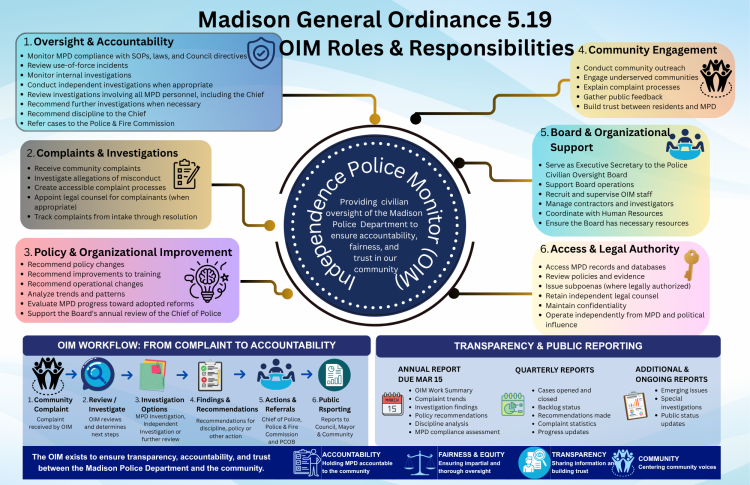
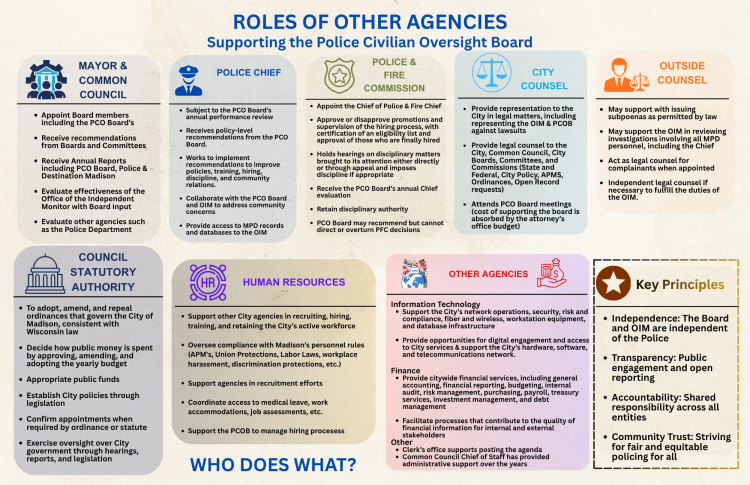
The language in MGO 5.19 and 5.20 defines the roles we each play in civilian oversight of the Police Department. The agency responsible for this work exists within the City's structure. It relies on the expertise and support of other departments, including the Clerk's Office, Human Resources, the City Attorney's Office, Information Technology, Finance, MPD, and others.


The ordinances intentionally distribute authority. They give the Common Council significant responsibilities while also clearly defining duties and responsibilities that fall outside the purview of the Council and City staff. Both are important. We need to follow the authority assigned to each role, understand those boundaries, and work within the framework the ordinances establish.

The Ghost of Council Past

  • MGO 5.20(1) "A Police Civilian Oversight Board ("Board") is hereby created for the City of Madison."  

  • MGO 5.20(2) "within the City of Madison" and "is independent from the MPD."

  • MGO 5.19(2) "The Monitor is classified as a managerial employee under MGO 3.54(9), with a specific exception: the Police Civilian Oversight Board recruits, hires, and supervises the Monitor.

  • MGO 5.19(4)(a) "The Board shall recruit and appoint the Monitor, with the assistance of the Common Council and Office of Human Resources."

  • MGO 5.19(4)(b) "The appointment of the Monitor by the Board shall not be effective unless and until confirmed by the Common Council." 

  • MGO 5.19 & MGO 5.20:  OIM and PCOB Ordinances

  • MGO 5.19(6)(b) "No City employee or official shall attempt to use their political or administrative position to unduly influence or undermine the independence of the Monitor or any employee of the OIM in the performance of their duties and responsibilities as set forth in this Ordinance.

The Ghost of Council Present

The 2020 Memos: A Look at the Issues We Are Still Debating

Today, as alders, we are scrutinized, chastised, and ridiculed not only by the public but by some former alders who, six years ago, created or voted for the ordinance we shall enforce. It has been eye-opening to watch them operate and manipulate a new generation of activists without the record to back it up.

While the City developed the two ordinances, the City Attorney raised multiple concerns and submitted them to 2020 Council via a couple of memos. These memos are relevant today and should be read as historical records of those discussions, not as substitutes for the enacted ordinance.

Memos:

July 13, 2020, Subpoena Authority of Independent Monitor and Civilian Oversight Board 

August 21, 2020, Independent Police Monitor/Civilian Oversight Body Discussion Topics

It is healthy to disagree about the effectiveness of the process, or whether more independence is needed, or even what the law permits. But debates should always begin with the actual language in MGO 5.19 and 5.20, any other applicable law, and the historical record.

Independence should be understood through what the ordinance says, not through assumptions, feelings, or expectations discussed in the Workgroup that have taken on a life of their own on social media.

The number one threat to civilian oversight today is the constant erosion of trust caused by disinformation, personal attacks, and narratives that fall apart when you check the facts.

MGO 5.20(5) also requires MPD and the Office of the City Attorney to attend every Board meeting. The ordinance states: "Staff from MPD and the Office of the City Attorney shall attend each Board meeting to answer any questions that may arise. Other City staff shall attend meetings when requested by the Board."

This is by design. Their expertise and knowledge of state statutes, City ordinances, and how the law applies to the Board's work are not obstacles to civilian oversight. It is part of the structure established to support the work.

The City Attorney's role is of most importance when legal questions arise. The Board needs to understand not only what it wants to do, but also what authority the law actually gives it. The City Attorney provides legal guidance and represents the City's interest in legal matters, including matters involving the Board. 

Two of the three lawsuits involving the Board have settled. In 2021, a federal lawsuit alleged racial discrimination in the Board's ordinance and composition. The City settled the case and subsequently amended the ordinance's demographic language. In a separate ERD/EEOC matter, an applicant alleged racial discrimination in the hiring process for the Independent Police Monitor position, including alleged racial comments by a Board member involved in hiring. That matter also settled. A third lawsuit remains ongoing.

Disregarding legal guidance and acting on disinformation without questioning the sources or their motives has real legal and financial consequences. Legal disputes take staff away from other work and consume public resources. If we are serious about effective, credible civilian oversight, then we need to deal with facts, respect the law, and listen to the expertise that the ordinance itself requires. We cannot claim to support accountability while ignoring the legal framework designed to guide the work.

Conclusion:

To those individuals who have self-proclaimed to be the warriors for these ordinances, please spare me the lectures about your community engagement, equity, and inclusion efforts when some of the loudest people preaching those values are targeting the very people they claim to protect. People who identify as lesbians, transgender people, Latinas, and Black women.

For those who feed the warriors: Stop pretending these tactics are new in Madison. You know who the main players are; they are the same people! I see you share their posts like it is the progressive gospel. Take a tablespoon of reality, a cup of unresolved grief, a splash of accusations, stir the story enough times, and suddenly you drink the Kool-Aid as a factual cure.

Long emails, social media rants, character assassination; same playbook, unchanged for decades. Somehow, checking the actual record is always too much to ask.

Equity and advocacy are not a free pass to manipulate people; you are not immune from accountability for your own conduct.

Bring the facts. 

Show the evidence. 

Answer for your claims.

That's what accountability looks like. 

Everything else is just noise dressed up as a movement.


The Future of the OIM & PCOB

As alders, most of my colleagues and I understand that the Common Council created this oversight structure and retains legislative authority over the ordinances that govern it. The PCOB may recommend changes, but changes to the ordinance must go through the Council's legislative process. The Council considers those recommendations and decides whether to adopt them.

This Council has repeatedly shown it understands the importance of civilian oversight. The vast majority of Madisonian want an oversight structure that is functional, effective, and worthy of public trust. The question is how we get there.

I believe the best path forward is to engage oversight experts, in this case the National Association for Civilian Oversight of Law Enforcement (NACOLE), and let them guide the work. I have heard passive-aggressive attacks against NACOLE's ability to guide this effort. I trust the majority of Council recognizes that language pattern for exactly what it is: an attempt to undermine progress. NACOLE's reputation speaks for itself.

Wis. Stat. § 62.11(5) establishes the Common Council's authority over City finances, including appropriations.

As part of the 2027 budget process, we introduced a Finance Budget Amendment last Friday to fund a sole-source contract with NACOLE to develop a comprehensive work plan. The work would include stakeholder engagement and public input, education on comparative civilian oversight models and their enabling ordinances, and an assessment of Madison's existing oversight structure.

A second amendment included funding for an investigator to help manage the caseload.

On Monday, the Finance Committee deliberated and amended the 2027 budget to include both amendments. The NACOLE amendment uses a one-time reallocation of salary savings to purchase services. This does not reduce the agency's budget, as some emails sent to Alders this week suggested. It is a one-time transfer of funds to pay for a specific service.

The full Common Council will vote on the amended budget in November for final approval. Additional details about NACOLE's work will be available once the Council adopts the amended budget and the contract between the city and NACOLE is finalized.

We have work to do. I am confident that bringing in experienced, independent expertise will help us evaluate the existing structure, identify opportunities for improvement, and strengthen civilian oversight in Madison.

There is a process for this work, and we need to let it move forward. Stay plugged in as the next steps take shape over the coming months.

Felicidades to the Brewers fans! YF-C

Current Structure according to the ordinances

OIM Duties -CORRECTED

Supporting Agencies

Other Agencies

PDF file format 

Categories:

Was this page helpful to you? * required