
Hudson Park
2919 Lakeland Ave.Madison, WI 53704 Directions
Acres: 4.75
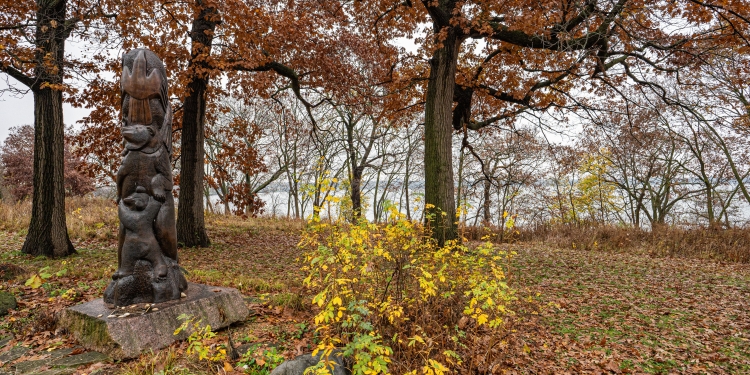
Hudson Park, located at 2919 Lakeland Avenue, stretches along the shores of Lake Monona and is complete with 4.75 acres of lake views, ancient mounds, and a bronze memorial dedicated to the Ho-Chunk Nation. Native American artist Harry Whitehorse, of the Ho-Chunk Nation, transformed a storm-damaged tree into a memorial honoring his ancestors in 1991. The sculpture, created from the trunk of a hackberry tree struck by lightning, contains carvings of a wolf, bear, cub, lynx, thunderbird, eagle, and a Ho-Chunk warrior and overlooks the burial mounds.
After careful restoration, the statue was cast in bronze and rededicated in 2009.
At this Park
Canoe and Kayak Launch
Access Lake Monona.
Fishing
People 16 years and older need a fishing license from the Wisconsin DNR.
Eating fish can be a delicious, low-cost, and nutritious meal. However, eating certain fish can also be harmful because they may contain mercury, PCBs, or PFAS. Learn more at Public Health Fish Advisories.
Native American Burial Mound - Elmside
Location: corner of Maple and Lakeland
Built: ca. 700 - 1200 A.D.
Description: Overlooking Lake Monona are two well-preserved animal burial mounds. Referred to for many years as a lynx and a bear, the actual animals or spirits that they were intended to represent is not entirely clear. These mounds were originally part of the same cluster as the Hudson Park mound.
These mounds were designated a City of Madison landmark on May 7, 1990, and are on the National Register of Historic Places.
The mounds are considered sacred by modern Native Americans and should be treated with respect.
Native American Mound - Hudson Park/Mill Woods
Built: ca. 700 - 1200 A.D.
Description: Overlooking Lake Monona is a long-tailed burial mound that has been referred to as a turtle, lizard, panther, and water spirit. Part of the tail was cut off when Lakeland Avenue was constructed. This mound was originally part of a dense and extensive cluster of mounds that extended from the Yahara River to what is now Olbrich Park. The site was still a favored Ho-Chunk campground as late as the late 19th century.
The Hudson Park Mound was designated a City of Madison landmark on May 7, 1990, and is on the National Register of Historic Places.
The mounds are considered sacred by modern Native Americans and should be treated with respect.