
Rezoning Planned Development Zones
Planned Development zoning is development-specific zoning, where specific use and development requirements are written for each individual PD zone. Conventional zoning districts are districts whose rules are wholly within the City's zoning code. Conventional zoning districts may be mapped and used in various areas throughout the city.
The City of Madison is proposing the rezoning of several single- and two-family Planned Development Zones (PDs) into conventional zoning districts. These conventional zoning districts primarily allow single- and two-family homes. In the Transit Oriented Development (TOD) Overlay District, three- and four-family homes are also allowed. None of the zoning districts being proposed for these PDs allow apartment buildings.
More details about the types of housing allowed in the conventional zoning districts being proposed for these properties can be found lower on this page.
SR-C1 Setback Requirements
All measurements are in feet unless otherwise noted:
| Category | Single-family detached | Two-family Two unit | Two-family - Twin | Nonresidential |
|---|---|---|---|---|
| Minimum Lot Area (sq. ft.) | 6,000 | 6,000 | 3,000 per dwelling unit | 8,000 |
| Minimum Lot Width | 55 | 55 | 27 per dwelling unit | 60 |
| Minimum Front Yard Setback | 30 | 30 | 30 | 30 |
| Minimum Side Yard Setback | 6 | 6 | 6 | 6 |
| Minimum Reversed Corner Side Yard Setback | 15 | 15 | 15 | 30 |
| Minimum Rear Yard Setback | Lesser of 30% lot depth or 30, see (1.) below; Alley accessed: 3, See (2.) below | Lesser of 30% lot depth or 30, see (1.) below; Alley accessed: 3, See (2.) below | Lesser of 30% lot depth or 30, see (1.) below; Alley accessed: 3, See (2.) below | Lesser of 30% lot depth or 35, see (1.) below |
| Maximum height | 2 stories/35 | 2 stories/35 | 2 stories/35 | 35 |
| Maximum lot coverage | 50% | 50% | 50% | 60% |
| Maximum building coverage | n/a | n/a | n/a | 50% |
- If the existing principal structure and any additions to it covers twenty percent (20%) or less of the lot area, the rear yard setback may be reduced by twenty-five percent (25%).
- Only a one-story, alley-accessed attached garage projection for garage purposes may have a minimum rear yard setback of three (3) feet.
Other requirements can be found in Chapter 28.035 of the zoning code.
SR-C2 Setback Requirements
All measurements are in feet unless otherwise noted:
| Category | Single-family detached | Two-family Two unit | Two-family - Twin | Nonresidential |
|---|---|---|---|---|
| Minimum Lot Area (sq. ft.) | 5,000 | 5,000 | 2,500 per dwelling unit | 6,000 |
| Minimum Lot Width | 50 | 50 | 25 per dwelling unit | 50 |
| Minimum Front Yard Setback | 30 | 30 | 30 | 30 |
| Minimum Side Yard Setback | 6 | 6 | 6 | 6 |
| Minimum Reversed Corner Side Yard Setback | 15 | 15 | 15 | 30 |
| Minimum Rear Yard Setback | Lesser of 30% lot depth or 30, see (1.) below; Alley accessed: 3, See (2.) below | Lesser of 30% lot depth or 30, see (1.) below; Alley accessed: 3,
| Lesser of 30% lot depth or 30, see (1.) below; Alley accessed: 3,
| Lesser of 30% lot depth or 35, see (1.) below |
| Maximum height | 2 stories/35 | 2 stories/35 | 2 stories/35 | 35 |
| Maximum lot coverage | 50% | 50% | 50% | 35 |
| Maximum building coverage | n/a | n/a | n/a | n/a |
- If the existing principal structure and any additions to it covers twenty percent (20%) or less of the lot area, the rear yard setback may be reduced by twenty-five percent (25%).
- Only a one-story, alley-accessed attached garage projection for garage purposes may have a minimum rear yard setback of three (3) feet.
Other requirements can be found in Chapter 28.036 of the zoning code.
SR-C3 Setback Requirements
All measurements are in feet unless otherwise noted:
| Category | Single-family detached | Two-family Two unit | Two-family - Twin | Nonresidential |
|---|---|---|---|---|
| Minimum Lot Area (sq. ft.) | 5,000 | 5,000 | 2,500 per dwelling unit | 6,000 |
| Minimum Lot Width | 50 | 50 | 25 per dwelling unit | 50 |
| Minimum Front Yard Setback | 25 | 25 | 25 | 25 |
| Minimum Side Yard Setback | 5 | 5 | 5 | 5 |
| Minimum Reversed Corner Side Yard Setback | 15 | 15 | 15 | 25 |
| Minimum Rear Yard Setback | Lesser of 30% lot depth or 30, see (1.) below; Alley accessed: 3, see (2.) below | Lesser of 30% lot depth or 30, see (1.) below; Alley accessed: 3, see (2.) below
| Lesser of 30% lot depth or 30, see (1.) below; Alley accessed: 3, see (2.) below
| Equal to building height but at least 35, see (1.) below |
| Maximum height | 2 stories/35 | 2 stories/35 | 2 stories/35 | 35 |
| Maximum lot coverage | 60% | 60% | 60% | 60% |
| Maximum building coverage | n/a | n/a | n/a | 50% |
- If the existing principal structure and any additions to it covers twenty percent (20%) or less of the lot area, the rear yard setback may be reduced by twenty-five percent (25%).
- Only a one-story, alley-accessed attached garage projection for garage purposes may have a minimum rear yard setback of three (3) feet.
Other requirements can be found in Chapter 28.037 of the zoning code.
TR-C1 Setback Requirements
All measurements are in feet unless otherwise noted:
| Category | Single-family detached | Two-family Two unit | Two-family - Twin | Nonresidential |
|---|---|---|---|---|
| Minimum Lot Area (sq. ft.) | 5,000 | 5,000 | 2,500 per dwelling unit | 6,000 |
| Minimum Lot Width | 45 | 45 | 22 per dwelling unit | 50 |
| Minimum Front Yard Setback | 20 | 20 | 20 | 20 |
| Maximum Front Yard Setback | 30 ft. or up to 20% greater than block average | 30 ft. or up to 20% greater than block average | 30 ft. or up to 20% greater than block average | n/a |
| Minimum Side Yard Setback | 6 | 6 | 6 | 10 |
| Minimum Reversed Corner Side Yard Setback | 15 | 15 | 15 | 15 |
| Minimum Rear Yard Setback | Lesser of 30% lot depth or 30, see (1.) below; Alley accessed: 3, see (2.) below | Lesser of 30% lot depth or 30, see (1.) below; Alley accessed: 3, see (2.) below
| Lesser of 30% lot depth or 30, see (1.) below; Alley accessed: 3, see (2.) below | Equal to building height but at least 35. see (1.) below |
| Maximum height | 2 stories/35 | 2 stories/35 | 2 stories/35 | 35 |
| Maximum lot coverage | 50% | 50% | 50% | 65% |
| Maximum building coverage | n/a | n/a | n/a | 50% |
- If the existing principal structure and any additions to it covers twenty percent (20%) or less of the lot area, the rear yard setback may be reduced by twenty-five percent (25%).
- Only a one-story, alley-accessed attached garage projection for garage purposes may have a minimum rear yard setback of three (3) feet.
Other requirements can be found in Chapter 28.042 of the zoning code.
TR-C2 Setback Requirements
All measurements are in feet unless otherwise noted:
| Category | Single-family detached | Two-family Two unit | Two-family - Twin | Nonresidential |
|---|---|---|---|---|
| Minimum Lot Area (sq. ft.) | 4,000 | 4,000 | 2,000 per dwelling unit | 4,800 |
| Minimum Lot Width | 40 | 40 | 20 per dwelling unit | 40 |
| Minimum Front Yard Setback | 20 | 20 | 20 | 20 |
| Maximum Front Yard Setback | 30 ft. or up to 20% greater than block average | 30 ft. or up to 20% greater than block average | 30 ft. or up to 20% greater than block average | n/a |
| Minimum Side Yard Setback | 5; If lot width < 50: 10% lot width | 5; If lot width < 50: 10% lot width | 5; If lot width < 50: 10% lot width | 10 |
| Minimum Reversed Corner Side Yard Setback | 12 | 12 | 12 | 20 |
| Minimum Rear Yard | Lesser of 30% lot depth or 30; Alley accessed: 3, see (1.) below | Lesser of 30% lot depth or 30; Alley accessed: 3, see (1.) below | Lesser of 30% lot depth or 30; Alley accessed: 3, see (1.) below | Equal to building height but at least 30 |
| Maximum height | 2 stories/35 | 2 stories/35 | 2 stories/35 | 35 |
| Maximum lot coverage | 65% | 65% | 65% | 65% |
| Maximum building coverage | n/a | n/a | n/a | 50% |
- Only a one-story, alley-accessed attached garage projection for garage purposes may have a minimum rear yard setback of three (3) feet.
Other requirements can be found in Chapter 28.043 of the zoning code.
TR-C3 Setback Requirements
All measurements are in feet unless otherwise noted:
| Category | Single-family detached | Two-family Two unit | Two-family - Twin | Nonresidential |
|---|---|---|---|---|
| Minimum Lot Area (sq. ft.) | 3,000 | 3,000 | 1,500 per dwelling unit | 4,000 |
| Minimum Lot Width | 30 | 30 | 15 per dwelling unit | 40 |
| Minimum Front Yard Setback | 15 | 15 | 15 | 15 |
| Maximum Front Yard Setback | 30 ft. or up to 20% greater than block average | 30 ft. or up to 20% greater than block average | 30 ft. or up to 20% greater than block average | n/a |
| Minimum Side Yard Setback | 5 Lot width < 50: 10% lot width | 5 Lot width < 50: 10% lot width | 5 Lot width < 50: 10% lot width | 5 |
| Minimum Reversed Corner Side Yard Setback | 8 (10 for garage) | 8 (10 for garage) | 8 (10 for garage) | 15 |
| Minimum Rear Yard | Lesser of 20% lot depth or 20; Alley-accessed: 3, see (1.) below | Lesser of 20% lot depth or 20; Alley-accessed: 3, see (1.) below | Lesser of 20% lot depth or 20; Alley-accessed: 3, see (1.) below | Equal to building height but at least 20 |
| Maximum height | 2 stories/35 | 2 stories/35 | 2 stories/35 | 35 |
| Maximum lot coverage | 75% | 75% | 75% | 75% |
| Maximum building coverage | n/a | n/a | n/a | 65% |
- Only a one-story, alley-accessed attached garage projection for garage purposes may have a minimum rear yard setback of three (3) feet.
Other requirements can be found in Chapter 28.044 of the zoning code.
TR-C4 Setback Requirements
All measurements are in feet unless otherwise noted:
| Category | Single-family detached | Two-family Two unit | Two-family Twin | Three-unit | Nonresidential |
|---|---|---|---|---|---|
| Minimum Lot Area (sq. ft.) | 4,000 | 4,000 | 2,000 per dwelling unit | 4,000 | 4,800 |
| Minimum Lot Width | 40 | 40 | 20 per dwelling unit | 40 | 40 |
| Minimum Front Yard Setback | 20 | 20 | 20 | 20 | 20 |
| Maximum Front Yard Setback | 30 ft. or up to 20% greater than block average | 30 ft. or up to 20% greater than block average | 30 ft. or up to 20% greater than block average | 30 ft. or up to 20% greater than block average | n/a |
| Minimum Side Yard Setback | 5 Lot width <50: 10% lot width | 5 Lot width <50: 10% lot width | 5 Lot width <50: 10% lot width | 5 Lot width <50: 10% lot width | 5 |
| Minimum Reversed Corner Side Yard Setback | 12 | 12 | 12 | 12 | 20 |
| Minimum Rear Yard | Lesser of 30% lot depth or 30; Alley accessed: 3, see (1.) below | Lesser of 30% lot depth or 30; Alley accessed: 3, see (1.) below | Lesser of 30% lot depth or 30; Alley accessed: 3, see (1.) below | Lesser of 30% lot depth or 30; Alley accessed: 3, see (1.) below | Equal to building height but at least 30 |
| Maximum height | 2 stories/35 | 2 stories/35 | 2 stories/35 | 2 stories/35 | 35 |
| Maximum lot coverage | 65% | 65% | 65% | 65% | 65% |
| Maximum building coverage | n/a | n/a | n/a | n/a | 50% |
- Only a one-story, alley-accessed attached garage projection for garage purposes may have a minimum rear yard setback of three (3) feet.
Other requirements can be found in Chapter 28.045 of the zoning code.
How do PDs work?
Each PD is unique, with rules for things like setbacks, building height, lot coverage, design, and the design review process.
The Common Council approves each PD and any specific amendments to the PD, with recommendations from the Plan Commission and Urban Design Commission.
Why do we have PDs?
Planned Development Zoning became popular in the 1980s due to alders, neighborhood stakeholders, and developers wanting a greater level of land use control, particularly in newer neighborhoods. Most of the value of a PD was upfront, in that it allowed entire neighborhoods to be designed at once.
What are some of the challenges with PDs?
PDs have highly-specific zoning text that was established when the PD was first created. This text is extremely difficult to change, meaning properties within that PD are locked into restrictions that were thought to be best practice at that time. Since these areas have their own zoning rules, they do not get the benefit of recent zoning code changes made by the City. While the City's zoning code may evolve over time to better reflect the needs of the City and its residents, a PD zoning text is more rigid. This makes it incredibly difficult for properties to make even incremental changes over time.
Also, because there are so many PDs across Madison, it is not feasible for the City to make the zoning rules for these individual PDs easily accessible online, like it is for conventional zoning districts. If a property owner living in a PD has a question about what is allowed on their property, it can take a significant amount of time for City Zoning staff to find the appropriate PD zoning document, read through its requirements, and provide an answer.
Some PDs require even the smallest property changes to go through architectural review boards comprised of developers or other property owners and get approval from that body before the City can issue a building permit for the project. The City does not have any control over these unelected bodies, and they can prevent City staff from approving something that would otherwise be allowed by the PD's zoning text or the Citywide zoning code.
City staff typically does not know who serves on these architectural review boards or have contact information for those members and can only tell a homeowner looking to build a deck or add an egress basement window in these PDs to try to track down those approvals before applying for a building permit.
How is the building permit process different in PDs?
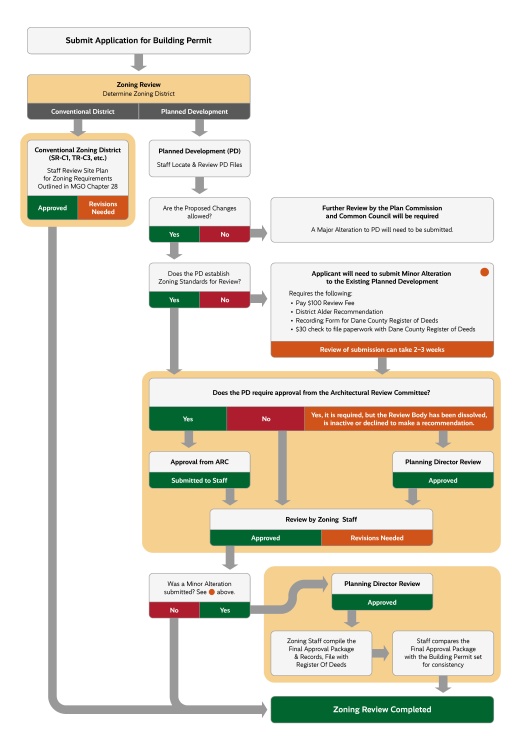
Applying for a building permit within a PD involves several steps and processes, including:
- Staff locating and reviewing PD files
- Determining whether the proposed changes are allowed within the PD
- If not, a Major Alteration to the PD will need to be submitted
- Determining whether the PD established Zoning Standards for review or if the PD allows projects to move forward without a Minor Alteration
- If not, the property owner needs to submit Minor Alteration to the PD, which includes:
- Paying a $100 review fee
- Getting a recommendation from their district alder
- Filling out a recording form for the Dane County Register of Deeds
- Paying a $30 filing fee for the Dane County Register of Deeds
- Waiting 2-3 weeks for the submission to be reviewed
- If not, the property owner needs to submit Minor Alteration to the PD, which includes:
- Determining whether the PD requires approval from an Architectural Review Committee, then the property owner getting that approval
- Additional review from Zoning staff after Architectural Review Committee approval
- If a Minor Alteration needs to be submitted, that alteration needs to be approved by the City of Madison's Planning Director
The process for conventional zoning districts is much simpler, with staff reviewing the site plan based on the zoning requirements for the zoning district, as outlined in MGO Chapter 28. If the site plan meets all requirements, it is approved by Zoning staff and the building permit is issued without any additional steps.
How can I tell if my property is in a PD?
You can enter your address into the City of Madison Zoning District Map or the City Assessor's Property Look-Up tool to find if your zoning district is PD.
What other restrictions may be on my property?
Beyond PDs, some properties may be subject to regulations from a homeowners' association or a private restrictive covenant. The City is not a party to these agreements, meaning it does not decide what is included in them and does not enforce them. If your property has valid covenants, you will most likely need to work with your homeowners' association or a similar group to work out what they enforce or review.
Legally, private covenants “run with the land," meaning they apply to the property itself and not the specific owner who originally made the agreement. You can usually find out if your property is under a covenant by finding the covenant in your title search documents or by doing research at the Register of Deeds.
It is the property owner's responsibility to determine if private covenants apply before starting a project on their property, regardless of what zoning district their property is in.
Why rezone my property to a conventional zoning district if my property will still have private covenants?
Not all covenants are the same, and not all homeowners associations enforce them to the same degree. Rezoning is the tool the City can use to help people have the most flexibility, since we are not a party to the private covenants.
Will assessments or fees for my Homeowners Association (HOA) be affected?
No, assessments and fees are not tied to a property's zoning district. Homeowners associations will still be able to collect fees like any other non-Planned Development (PD) zoned property and use them to fund operations, maintenance of common amenities and property, etc.